
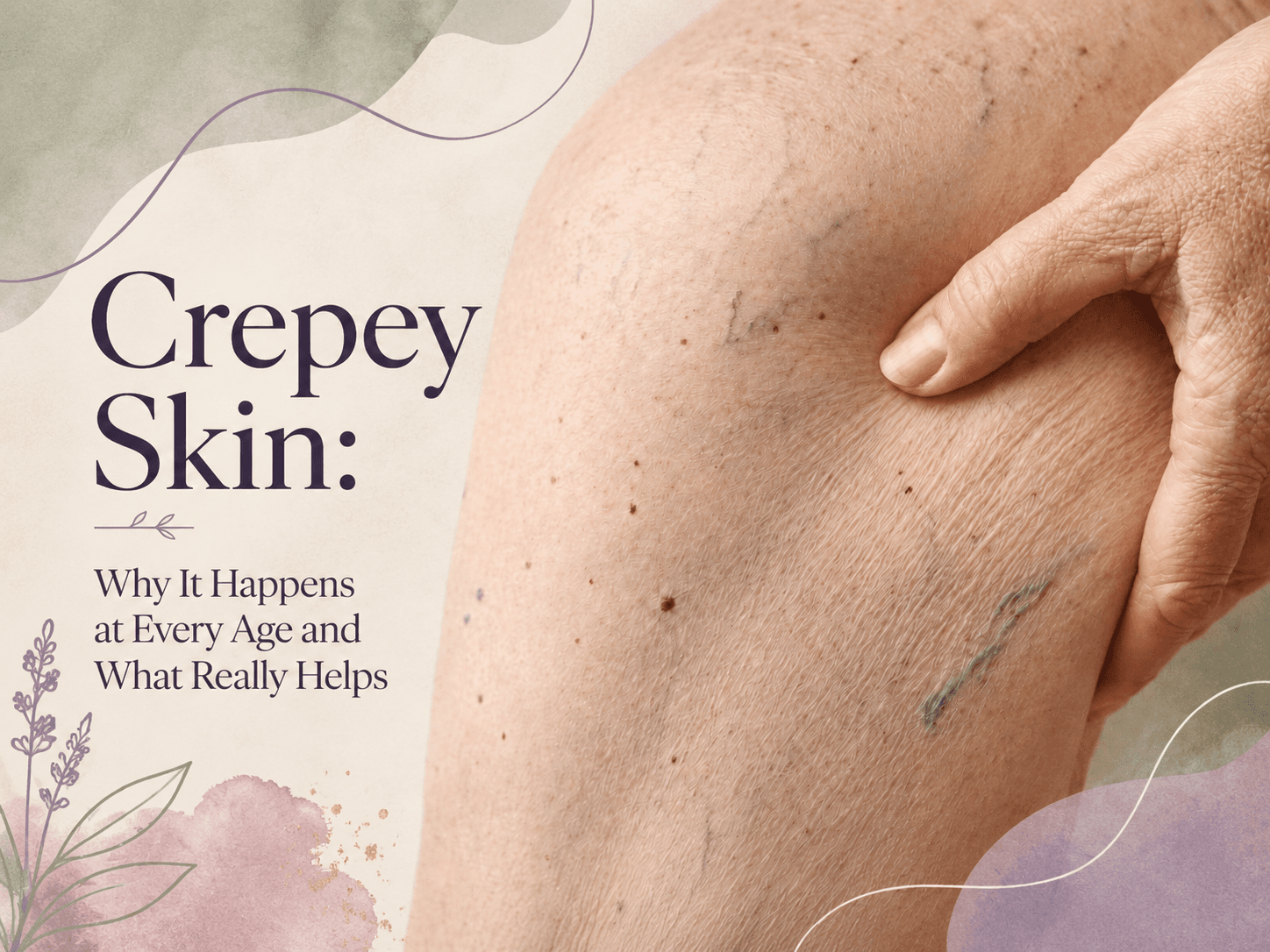
Crepey Skin: Why It Happens at Every Age and What Really Helps
A complete guide to preventing and treating crepey skin. Learn why skin loses its bounce, the best active ingredients to use, and a decade-by-decade plan to restore collagen and elasticity.
Quick Take
- Crepey skin comes from a real, measurable drop in collagen and elastin. It isn't just "getting older", and it isn't in your head.
- Sun exposure speeds it up more than almost anything else, even on cloudy days and even through a car window.
- Prevention works best in your 30s and 40s, but improvement is still very possible once crepiness has already set in.
- Biostimulators, PRP, medical-grade skincare, and microneedling can all help rebuild what time and sun have worn away.
If you've noticed skin on your inner arms, neck, or under your eyes starting to look thinner and finely wrinkled, almost like tissue paper that's been balled up and smoothed back out, you're looking at crepey skin. It shows up most on the areas with thinner skin to begin with: the neck, décolletage, under the eyes, inner arms, and the backs of the hands.
It's different from the deeper wrinkles that form from repeated facial expression. Crepey skin is about a loss of structure underneath: less collagen holding things up, less elastin snapping things back into place, and a thinner outer layer that shows every fold.
Crepey skin doesn't usually appear overnight. There are a few early signs worth paying attention to, especially if you're in your 30s or early 40s and want to get ahead of it rather than react to it.
- Skin that takes a moment to bounce back when you pinch it gently, rather than snapping back right away.
- A fine, crinkled texture on the inner arms or under the eyes that you notice more in certain lighting, like direct sun or a bathroom mirror.
- Skin that looks slightly thinner or more translucent than it used to, sometimes with veins becoming a bit more visible.
- A loss of the smooth, even texture you're used to, even before any actual wrinkles show up.
- Skin on the neck or décolletage that creases more easily and takes longer to smooth back out.
If any of this sounds familiar, it's a good time for a skin consultation rather than a wait-and-see approach. Catching it early is where prevention and lighter treatments do the most good.
Collagen production starts slowing down in your mid-20s and the drop becomes much more noticeable by your 40s. Elastin, the protein that lets skin stretch and bounce back, follows a similar path but doesn't regenerate the way collagen can. Once it's damaged, it tends to stay that way, which is why prevention matters so much.
UV rays break down collagen fibers a little at a time, and that damage adds up quietly over decades before it ever shows on the surface. Many clients tell us they took good care of their skin in their 20s and 30s, only to notice crepiness appear seemingly overnight in their 40s. In reality, it was building the whole time. Sun damage is cumulative and largely irreversible without help, which is exactly why daily SPF matters even on cloudy Burlington winter days.
Estrogen plays a real role in keeping collagen production steady, and levels start to shift during perimenopause, often years before periods actually stop. Many women notice their skin's texture change around the same time as other perimenopausal symptoms like disrupted sleep or irregular cycles, and that's not a coincidence. Some research points to skin losing a significant share of its collagen in the first few years after estrogen starts to decline, which is a steeper drop than the slow, steady loss that comes with age alone. That's part of why crepiness can seem to arrive quickly in your 40s and early 50s rather than gradually.
Some women find that topical estrogen cream helps support skin thickness and elasticity during this stage, since it addresses the hormonal piece directly rather than just the surface. This isn't something to start on your own, though. It needs to be discussed with your doctor, since it involves weighing your personal and family health history, and it's usually managed alongside your broader perimenopause care rather than as a standalone skincare step. If you're already working with your family doctor or a menopause specialist on hormone therapy, it's worth asking whether a topical estrogen option makes sense for your skin as part of that conversation.
Skin doesn't age in isolation. The fat pads and bone structure beneath it also shift over time, and as that underlying support thins out, the skin above it has less to hold onto. That's part of why crepiness often shows up alongside a general sense that the face or arms have lost some of their fullness.
- A broad-spectrum SPF every single day, reapplied if you're outside for long stretches.
- Staying genuinely hydrated, since dehydrated skin shows fine lines and texture change faster.
- Gentle cleansing rather than hot water and harsh scrubbing, which weakens the skin barrier.
- Not smoking, and cutting back where you can, since it accelerates collagen breakdown significantly.
- Sleeping on your back or on silk when possible to reduce repeated creasing on the same areas.
- Regular exercise, since it improves circulation and helps deliver oxygen and nutrients to skin cells, supports collagen production, and lowers the stress hormones that break collagen down over time.
Of everything in this section, a good moisturizer is probably the single change that makes the fastest, most visible difference, and that holds true at every age. Crepey texture is partly a mechanical effect: skin that's properly hydrated plumps up at the surface, which genuinely smooths out fine lines and softens that crinkled look, sometimes within days of starting a richer product. This isn't just a temporary illusion either. Well-hydrated skin supports a stronger barrier over time, and a strong barrier is what protects the collagen and elastin underneath from further breakdown.
As we get older, skin naturally produces fewer of the lipids that normally keep moisture locked in, which is a big part of why skin tends to look and feel drier with age. With fewer of those lipids in place, skin has a harder time holding onto water on its own, so a lighter lotion that worked fine in your 20s or 30s often isn't enough later on. This is why switching to a noticeably thicker, more emollient moisturizer as you get older tends to make more of a difference than adding more products to the routine. If you only make one change after reading this, switching to a moisturizer that's actually rich enough for your skin, and using it consistently on your face, neck, and any other areas showing crepiness, is the one most people notice the fastest.
A retinoid remains one of the best-studied ingredients for stimulating collagen turnover. Peptide serums support the skin's own repair signals, and one worth knowing by name is Matrixyl, a peptide that works by signaling your skin to behave as though it's healing, which prompts it to produce more collagen on its own. Over consistent use, that translates into visibly firmer, more elastic skin, and it's gentle enough to use alongside a retinoid without much irritation, which makes it a good fit for skin that's already sensitive. Vitamin C helps protect against daytime UV and pollution damage, and hyaluronic acid helps skin hold onto moisture so it looks plumper day to day.
An AHA like glycolic or lactic acid, used a few times a week, gently resurfaces the top layer of skin and helps your other products absorb better, which matters more as skin gets thicker and less able to shed on its own with age. Glycolic acid is the most well-studied AHA and tends to penetrate a bit deeper than lactic acid, so for an at-home product, look for a concentration of 20 percent or less to avoid over-irritating your skin. Lactic acid in particular is gentler than glycolic and tends to suit thinner, more sensitive skin well, and it works just as well on the body as it does on the face. In an at-home product, look for a concentration somewhere in the 5 to 15 percent range. Urea is another exfoliant worth knowing about, especially for rougher patches on the arms and legs, since it softens and lifts dry, thickened skin while also drawing in moisture at the same time. For it to really work on thicker, rougher skin, look for a concentration of at least 10 percent. Retinoids aren't just a facial product either. Body formulations designed for the arms, chest, and hands exist too, and they're worth using on the areas that show crepiness most, not just your face. We carry AlumierMD's Canadian line in clinic (see ca.alumiermd.com for full product details and Canadian SPF ratings) and can help you build a routine suited to your skin rather than guessing at what's on a drugstore shelf.
We'll be honest with you here: a great skincare routine can slow down new damage and improve the surface quality of your skin, but it has real limits once collagen and elastin have already broken down significantly. That's where in-clinic treatments come in, and where a proper consultation makes a real difference in setting expectations.
There's no single age when you should start paying attention to this. What actually helps changes as your skin changes, so here's a general guide for what tends to make the biggest difference at each stage. Everyone's skin is different, and this is meant as a starting point for a conversation with our team, not a strict prescription.
This is the decade where prevention does the most work for the least effort, because collagen and elastin levels are still strong. The goal is simply to stop unnecessary damage from building up.
- Skincare: a broad-spectrum SPF every morning without exception, a gentle cleanser, an antioxidant serum like vitamin C in the morning, and a basic hyaluronic acid moisturizer.
- A low-strength retinoid a couple of nights a week can be a good idea toward the late 20s, introduced slowly.
- Treatments: not usually necessary yet, though a gentle IPL treatment can be worth considering if you already have visible sun damage or uneven tone. A skin consultation to build good habits early is often the most valuable thing you can do.
- Lifestyle: this is the decade to build a consistent exercise habit. Regular movement supports healthy circulation and collagen production now, and the earlier it becomes routine, the more it pays off later.
Collagen decline becomes measurable in this decade, even if nothing looks different yet. This is the sweet spot for building habits that pay off later.
- Skincare: a nightly retinoid at a strength your skin tolerates, a peptide serum, an AHA a couple of times a week to keep skin resurfacing properly, continued daily SPF, and an eye cream if you're noticing early thinning under the eyes.
- Treatments: this is a good decade to start preventive biostimulator or skin booster treatments, especially if you have a family history of early skin aging or spent a lot of time in the sun earlier in life. IPL and red LED light therapy also fit well here as gentler, low-downtime options.
- Microneedling can also be introduced here to support collagen turnover before significant loss occurs.
- Lifestyle: strength training becomes especially valuable in this decade, since building and maintaining muscle helps support the structure underneath your skin, and consistent cardiovascular exercise keeps circulation strong.
This is often when crepiness first becomes noticeable, especially with the added shift from perimenopause. The approach shifts from purely preventive to a mix of prevention and active rebuilding.
- Skincare: a stronger retinoid if your skin tolerates it, peptide and growth factor serums, a richer moisturizer to support a thinning skin barrier, and SPF that stays non-negotiable.
- Treatments: biostimulators and PRP or PRF to rebuild collagen, skin boosters for the neck, décolletage, and arms, chemical peels to keep resurfacing skin that's shedding more slowly, red LED light therapy to support ongoing collagen production, and microneedling for overall texture.
- This is often the decade where it's worth moving from gentler IPL toward a more intensive option like CO2 laser resurfacing, especially if textural changes are becoming more noticeable.
- Vitamin therapy such as Vitamin D3, NAD+, or Glutathione can support skin health from within alongside in-clinic treatments.
- If you're noticing skin changes alongside other perimenopausal symptoms, it's worth raising topical estrogen with your doctor as part of your broader care.
- Lifestyle: regular exercise matters even more here, since it helps offset some of the effects of shifting hormones on circulation, muscle tone, and stress levels, all of which show up in your skin.
Skin tends to be thinner and drier in this stage, so the focus shifts toward supporting the barrier while continuing to rebuild collagen wherever possible.
- Skincare: rich, barrier-supportive moisturizers, a retinoid or retinoid alternative as tolerated, peptide serums, a gentler AHA used less frequently since skin can be more sensitive at this stage, and SPF every single day.
- Treatments: a combination approach tends to work best here, layering biostimulators, PRP or PRF, skin boosters, chemical peels, red LED light therapy, and microneedling based on your specific areas of concern.
- CO2 laser resurfacing tends to be the most impactful laser option at this stage, since it works at a deeper level to rebuild collagen in skin that's already lost significant structure.
- Ongoing vitamin therapy and ongoing conversations with your doctor or our NP about hormone-related changes remain worthwhile at this stage too.
- Lifestyle: staying active continues to support circulation and muscle tone underneath the skin, and it remains one of the simplest ways to support your overall health, which shows up in your skin as much as anywhere else.
Physician-dispensed retinoids and peptide formulations go beyond what's available over the counter, both in ingredient concentration and in how they're formulated to actually absorb. This is usually our first recommendation for clients in their late 30s and early 40s who are noticing early changes.
For skin where collagen loss is already visible, a few of our treatments are built specifically to rebuild structure rather than just hydrate the surface.
- Biostimulators, which work with your own body over several months to gradually rebuild collagen from within.
- PRP and PRF, which use your own blood's growth factors to support tissue regeneration and improve skin quality and texture.
- Skin boosters, which improve hydration and elasticity and work especially well on the neck, décolletage, and arms.
- Microneedling with our Eclipse MicroPen EVO, a Health Canada Class II device that creates controlled micro-injury to trigger the skin's own repair process.
- AlumierMD chemical peels, which use targeted acids like lactic or glycolic acid, often around 30 percent at professional strength, to resurface the top layers of skin, improve tone and texture, and help thicken the deeper layers of skin over a series of sessions. These peels can be done on the body as well as the face, wherever crepiness shows up. For rougher body areas, professional-strength urea-based exfoliation is also worth asking about.
- Red LED light therapy, which stimulates collagen production, calms inflammation, and supports circulation. It's gentle enough to use often, whether that's an at-home LED facemask for regular upkeep or a longer in-clinic red light session for the face or body.
- Laser and light-based resurfacing, which ranges from gentler options for early sun damage to more intensive resurfacing for deeper textural change, depending on your skin and stage of life.
- Vitamin therapy, including Vitamin D3, NAD+, and Glutathione, which supports skin health from the inside out alongside whatever we're doing topically or in-office.
Laser and light-based treatments aren't one-size-fits-all, and the right one tends to shift as your skin changes. In your 20s and 30s, a gentler option like IPL is usually enough to target early sun damage and support even tone before any real structural loss has happened. By your 40s and 50s, skin often benefits from something more intensive like CO2 laser resurfacing, which works at a deeper level to stimulate significant new collagen production in skin that's already lost some of its structure. Neither one is better across the board. It's about matching the intensity of the treatment to how much rebuilding your skin actually needs at the time.
If you're in your late 30s, 40s, or beyond and starting to notice thinner, finely lined skin on your neck, arms, or under your eyes, you're a good candidate for a conversation about prevention and treatment together. This approach tends to work best for people who are generally healthy and want a non-surgical way to support their skin's structure rather than mask the surface.
Every plan starts with a proper consultation with our RN or NP team so we can look at your specific skin, talk through your goals, and build a combination that makes sense for you. There's no single right answer here, and that's exactly why we don't do one-size-fits-all treatment plans for clients across Burlington, Oakville, Hamilton, Milton, and the Halton Region.
Every skin tells a different story. Our RN-led team will look at yours and build a plan that actually fits your skin, your goals, and your budget.
3455 Harvester Rd, Unit 10, Burlington, Ontario L7N 3P2
Continue reading
Why Your Skin Broke Out After You Stopped the Pill
Stopped the pill and your chin is staging a protest? Discover why post-pill acne happens, how long the hormonal rebound actually lasts, and how to gently support your skin while it recalibrates.
Read article
Am I Too Young for This? Early Signs of Perimenopause in Your Late 30s
Think perimenopause is only a problem for your 40s? Learn why it often begins in your mid-to-late 30s, the early skin signs to watch for, like sudden dryness and hormonal acne, and how to adjust your skincare routine for these new hormonal shifts.
Read article
My Baby Turned Two and My Skin Still Isn't Mine
What happens when postpartum skin changes outlast the one-year timeline everyone quotes? Discover the science behind long-term hormonal shifts, lingering pigmentation, and how to gently manage your skin during the toddler years.
Read article